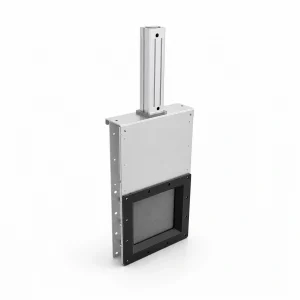
Slide gate: open or close the material route
A slide gate valve uses a sliding blade to open or block an outlet. Define whether it closes with material present, the column load above it, required sealing and available actuator space. An open/close command is not proof that the blade reached its position; feedback matters in an automated sequence.
Do not assume a standard slide gate provides accurate dosing or gas-tight isolation. These requirements need an appropriate specified design.
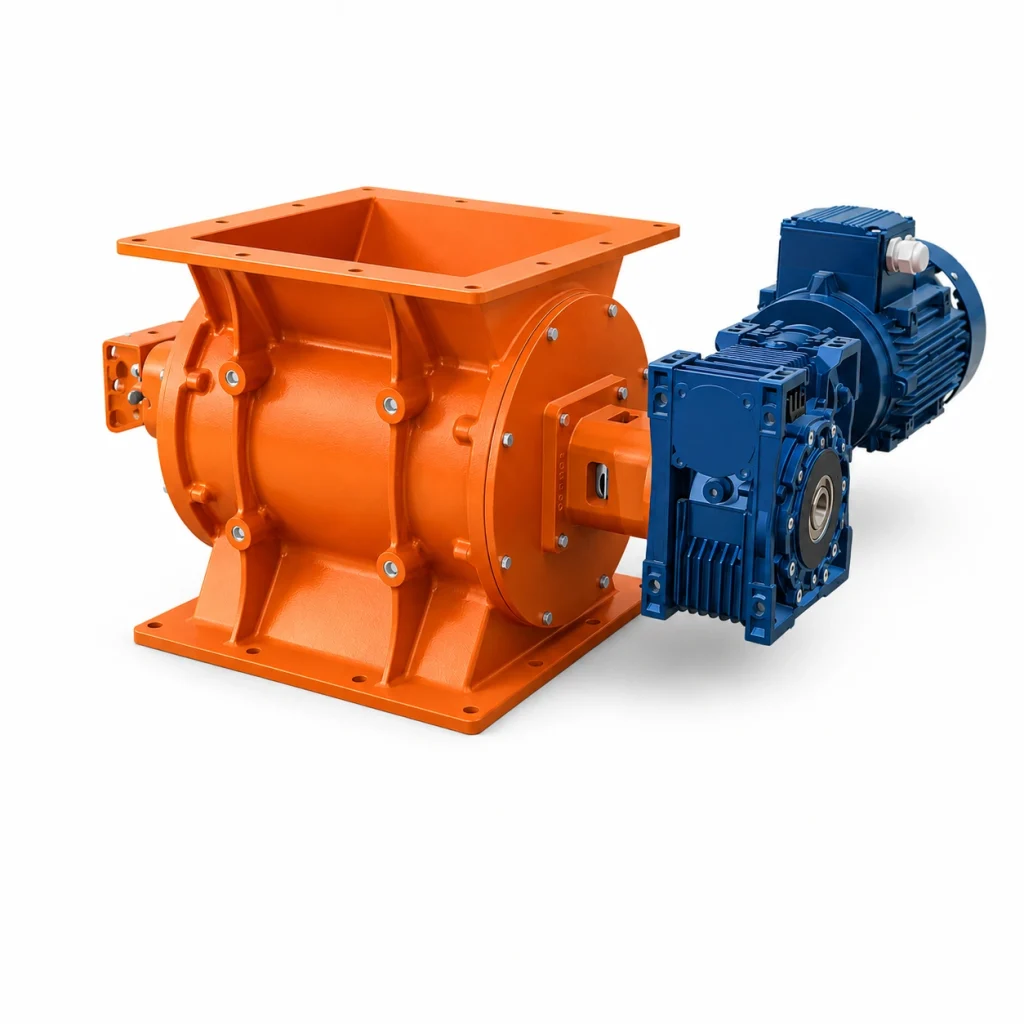
Rotary valve: transfer material through pockets
A rotary valve moves material through successive rotor pockets. Delivery depends on pocket volume, filling, speed and bulk density. A pressure-differential duty also needs a suitable airlock design: leakage air and venting affect performance.
Check particles, abrasiveness, temperature, rotor clearance and cleaning access. A standard rotary valve is not automatically an explosion-isolation device; that function requires the specific certified execution and installation conditions.
Diverter: choose the destination
A diverter flap valve directs a stream to an alternative outlet. Specify the number of routes, gravity or pneumatic service, product retention and whether switching occurs only after flow stops. Confirm the permitted switching duty for the selected design.
For example, when feeding two receiving hoppers, the control must confirm the selected path and that the destination can accept material before starting the upstream feeder. A diverter does not itself weigh the batch. If the process needs a defined batch weight or mass flow, compare volumetric and gravimetric dosing before defining the complete system.
For a quote
Write one specification for the complete connection
- Material, particle size, normal and peak rate.
- Inlet/outlet size, orientation and pressure conditions.
- Actuator, available power or air supply, position feedback and required failure position.
- Sealing, wear parts, cleaning and maintenance clearance.
Cement and minerals often emphasise abrasion; food and feed require contamination and cleaning controls; chemicals and plastics require compatibility and dust-hazard information. Select each component for its actual duty and verify the whole sequence before operation.
For an existing installation, state whether the problem is incomplete closure, material leakage, irregular delivery or incorrect routing. Record when it occurs and include the equipment label, connection dimensions and a photograph or layout. These are different symptoms and may require different component selections. Where pneumatic actuation or position monitoring is required, provide the details needed to assess the pneumatic actuator and position switch; compatibility must be checked for the valve assembly.