What happens during filling

Pneumatic filling brings powder and conveying air into the silo. As the powder accumulates, air must leave through the vent filter. The filter medium retains entrained dust; in a pulse-cleaned unit, short bursts of compressed air release collected dust back into the silo. The filter must pass the required airflow while the silo remains within its permitted pressure range.
Record whether the plume appears at the start, throughout filling or near the end. Tanker blowdown at the end can produce a high air demand even when little powder remains. Average delivery tonnage alone therefore cannot define the required vent-filter capacity.
Match the symptom to the right check
Dust from the filter’s air outlet
Have the filter elements, seating and seals inspected for damage or bypass leakage. Note whether the problem started after cartridge replacement. A clean-looking exterior does not establish that the elements are intact.

Dust around a flange, cover or filling connection
Locate the actual leak before choosing a filter. Check joint condition and the pressure history together; replacing cartridges will not repair a leaking flange.
Rising filter differential pressure
Compare readings at similar filling airflow. Loaded media or ineffective pulse cleaning may be involved. Check the cleaning-air supply, controller and pulse valves against the unit’s manual. Differential pressure across the filter is not the same as silo pressure.

Dust from a relief valve or a pressure alarm
Treat this as a filling/pressure-protection issue. Follow the site’s safe stop procedure and have the vent path, available silo space, delivery sequence and protective devices checked before restart. Do not block the valve or raise alarm settings to continue filling.
Application photograph from the eQUIP archive. It shows the installation context, not a diagnosed fault.
Three functions that work together
- Vent filter
- Separates dust from the air leaving the silo during normal filling. Its duty depends on air volume, dust and allowable pressure loss.
- Pressure protection
- A correctly selected relief device protects against specified abnormal pressure conditions. It is not the normal dust outlet and is not a substitute for adequate venting.
- Level and filling controls
- A high-level signal helps prevent overfilling when correctly integrated into the filling controls. Level indication and pressure protection perform different jobs.
Repair, replace or resize?
Restore the existing arrangement first when the problem is a damaged seal, unsuitable cartridge or failed cleaning component. Consider replacement cartridges only after checking their dimensions, sealing, media and suitability for the material. Review the complete filter duty if the filling rate, conveying-air supply, material or simultaneous filling conditions have changed.
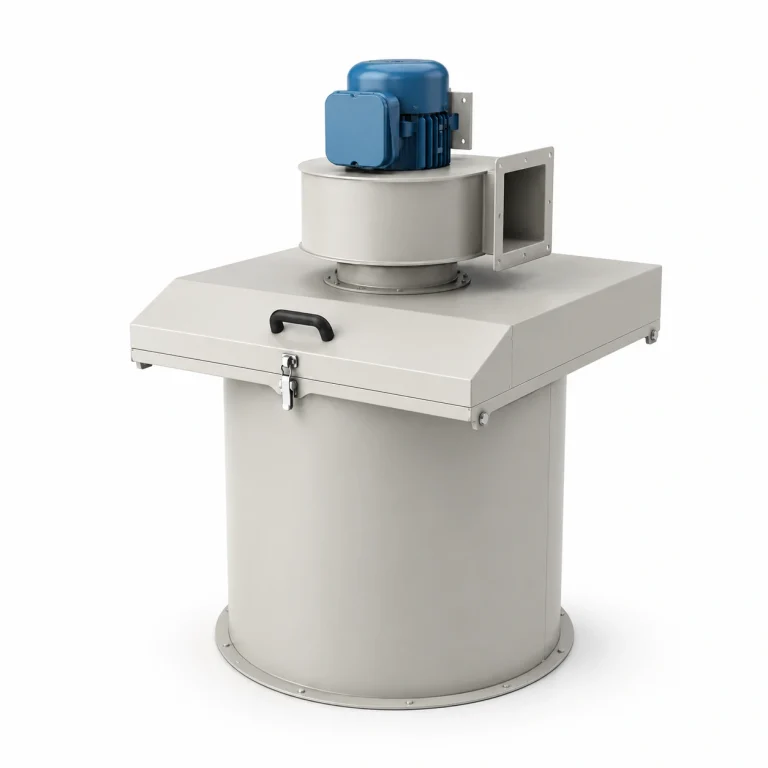
A fan-assisted filter is a separate extraction design choice, not an automatic cure for dust. Fan duty and pressure losses must be matched to the process and the silo’s permitted pressure/vacuum range. Do not size a filter by silo tonnes alone or increase pulse pressure without the equipment manufacturer’s limits.
The same process in other industries
The venting principle also applies to other pneumatically filled powder silos. These are application links, not a claim that one standard filter suits every material.
For combustible dust, the filter, silo and connected equipment need a coordinated explosion-risk assessment. An antistatic cartridge or an ATEX-rated component alone does not establish conformity of the complete installation.
Prepare a useful enquiry
- Material name and safety data sheet; available particle-size, moisture, temperature and bulk-density data.
- Delivery method, conveying airflow with its reference conditions, filling duration, peak/end-of-delivery conditions and any simultaneous deliveries.
- Silo and filter model, element type, permitted operating pressure, and filter differential-pressure readings if available.
- Where and when dust appears, alarm history, recent changes and maintenance records; photographs from a safe location.
Inspection and maintenance must be performed by authorised personnel after the required isolation and depressurisation. Do not open a filter or climb onto a silo during filling to obtain information.
Use the filter calculator for a preliminary estimate with documented airflow assumptions. Final selection also needs dust properties, cleaning duty and the installation’s pressure limits.