Start with the bag and its outlet
Specify filled weight, dimensions, lifting loops, discharge-spout diameter and length, and whether there is an internal liner. These details determine lifting clearance and the docking arrangement. A liner that is not properly retained can obstruct the outlet or enter downstream equipment.
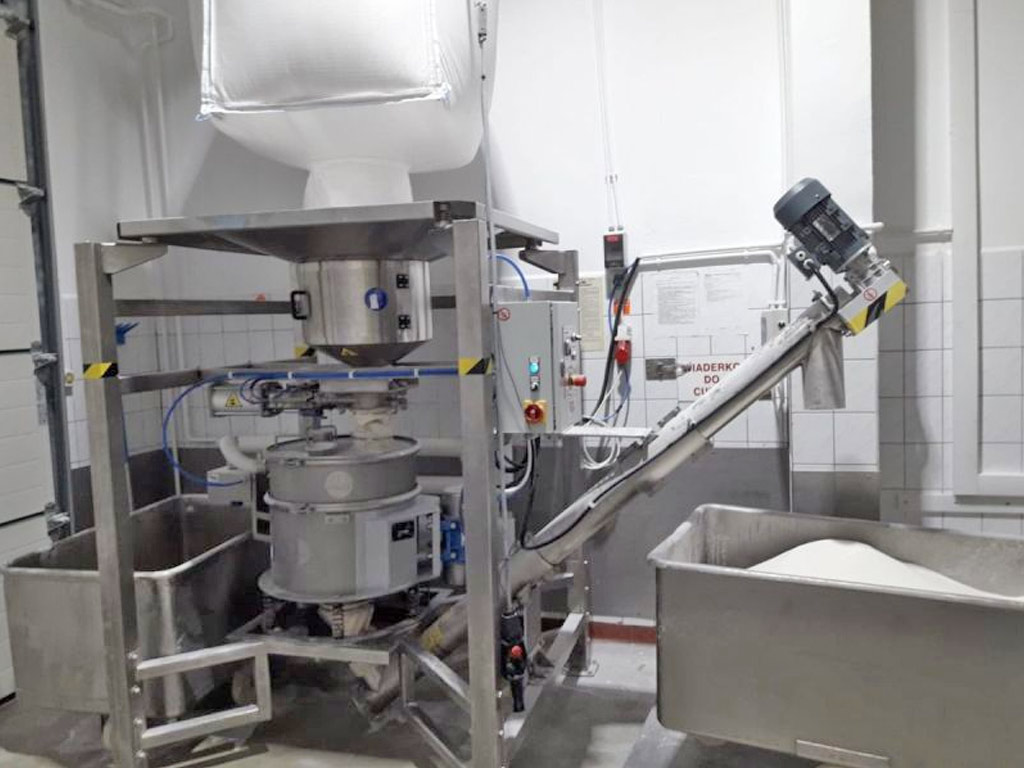
The spout connection should be made within a suitable access enclosure before releasing material. Dust may escape while connecting, emptying or removing the bag, so assess the entire changeover.
Keep the process running during bag changes
The receiving hopper can provide a buffer between intermittent bag handling and continuous production. Estimate the usable buffer from consumption and changeover time: at 600 kg/h, a five-minute change consumes 50 kg. This is only the material reserve; additional operating margin, bulk density and usable hopper volume must be assessed.
Level signals should coordinate bag discharge and the downstream feeder. A full receiving hopper must prevent further uncontrolled discharge.
Add accessories only for a defined need
- Compacted material may need a compatible bag-massaging arrangement.
- Lumps or foreign objects may require screening or separation before the feeder.
- Controlled weighing requires a weighing arrangement and control sequence; a discharge frame alone does not provide dosing accuracy.
- Select screw or pneumatic transfer from the required route and material behaviour.
For a quote
Define cleaning and the operating cycle
Food and feed applications need a cleaning and cross-contamination plan. Chemicals require compatibility and exposure data; plastic powders may require dust-hazard assessment. Specify whether partially emptied bags will be removed and how the spout is safely reclosed.
Provide bag details, material properties, bags per hour, peak consumption, changeover time and available height. Include lifting equipment and access requirements. Personnel must not work beneath suspended bags.
Send the material data and a photograph or layout of the installation so we can define the equipment and connection requirements.