
Choosing a cement silo: capacity, construction and total cost
A cement silo stores bulk cement between deliveries and production. For a concrete batching plant or another industrial installation, the right purchase depends on usable storage, delivery access and the equipment needed to fill and discharge the silo. Compare the complete installed scope, rather than the vessel price alone.
Welded cement silos: 40, 60, 80 and 100 tonnes
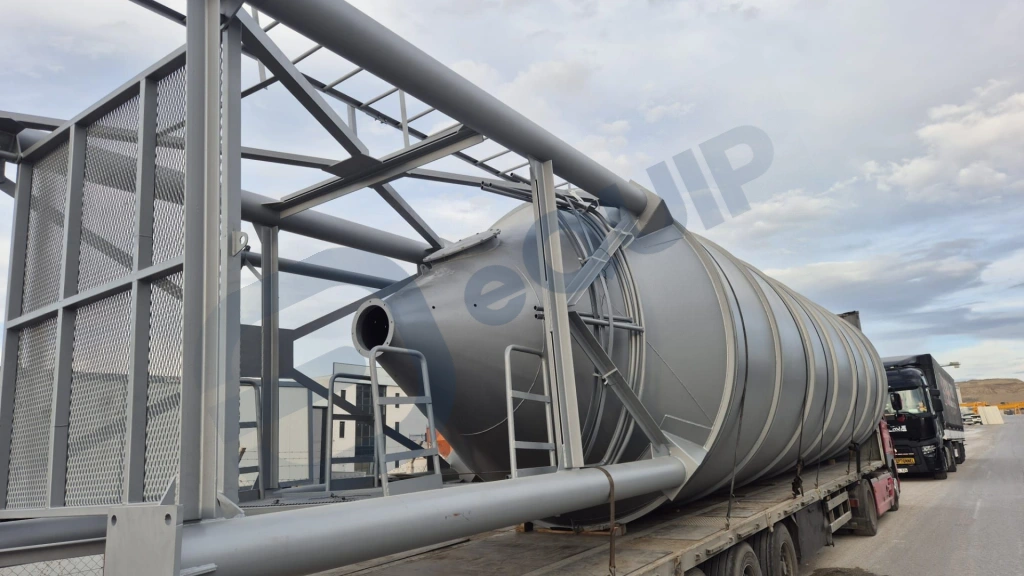
eQUIP manufactures welded cement silos in 40, 60, 80 and 100 tonne configurations for cement, with intermediate capacities available to suit the project. The silo body is delivered in one piece. Site installation remains the customer's responsibility; lifting, foundations and connections must be planned before delivery.

Bolted cement silos for modular delivery
A bolted silo is delivered in sections and assembled at the installation site. This approach can suit export projects or sites where transporting a complete welded body is impractical. Confirm the packing arrangement, site assembly requirements and lifting access before selecting it. Compare freight and assembly together: modular transport does not automatically mean a lower total project cost.

How much does a cement silo cost?
A useful cement silo price must identify its capacity, construction and supply scope. Two offers labelled “100 tonnes” may include different equipment, delivery terms and site work. eQUIP provides a project-specific quotation rather than a single price that could misrepresent your installation.
- Storage: cement type, required usable capacity and the basis of the tonnage rating.
- Construction: welded or bolted body, supports, outlet interfaces and coating requirements.
- Equipment: filling filter, level indication, discharge valve and any required conveying equipment.
- Logistics: destination, transport dimensions, unloading and access restrictions.
- Site scope: foundations, lifting, assembly, connections and commissioning responsibilities.
- Commercial terms: freight, applicable taxes, exclusions and quotation validity.
What is included with an eQUIP welded silo?
The standard scope includes the ladder, guardrails, support legs and filling pipe, with primer and paint. The filter, level sensor and valve are optional. Sandblasting can be requested. Specify the required options when comparing offers; do not assume that all equipment shown in a project photograph is included.
Choosing storage capacity without confusing tonnes and throughput
Storage capacity in tonnes is different from conveying throughput in tonnes per hour. The mass held by a silo depends on the material's bulk density and usable volume. Start with the delivery quantity, cement consumption and intended reserve, then confirm the selected configuration. A nominal 100 tonne cement silo does not necessarily hold 100 tonnes of another powder.
Send these details for a comparable silo quotation
- Material and required storage capacity, explicitly in tonnes or cubic metres.
- Number of silos and preferred welded or bolted construction, if known.
- Delivery country, city and site access limitations.
- Filling, filtration, level monitoring and discharge equipment required.
- Available space, connection heights and any existing layout or drawing.
You can start an enquiry without having every technical answer. Put the storage requirement in the project message, for example “cement storage: 100 metric tonnes”; state discharge throughput separately if known.


